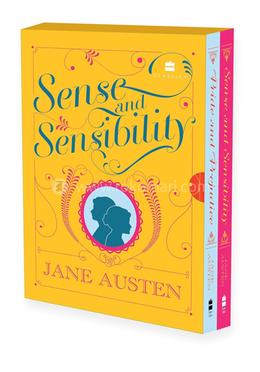
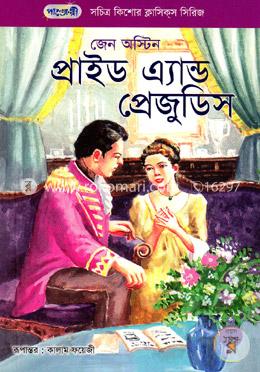
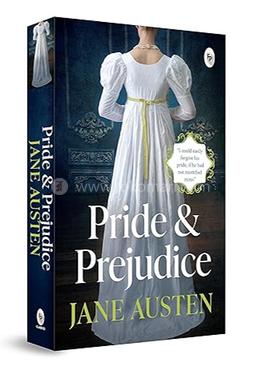
When the wealthy and handsome Mr Bingley arrives in the quiet village of Longbourn, he causes a stir-especially in the Bennet household, where Mrs Bennet is eager to marry off her five daughters. At a ball, Mr Bingley shows an interest in
the eldest Bennet daughter, Jane, while his friend, the proud and aloof Mr Darcy, snubs Elizabeth, Jane's quick-witted and independent sister. As the two are thrown together again and again, Elizabeth's prejudice and Darcy's pride slowly begin to unravel.
Pride and Prejudice is a witty and classic tale of two strong-willed people who must confront their own flaws to discover that true happiness can only be found when both pride and prejudice are set aside.
*****
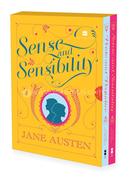
Elinor and Marianne Dashwood are sisters, yet their temperaments are in stark contrast to one another. Elinor, governed by reason and restraint, embodies the quiet strength of sense, while her younger sister, Marianne, embraces life with passion and abandon, guided by sensibility. Following their father's death, the Dashwoods must contend with the uncertain ground of love, loss and societal expectation. As Marianne suffers the anguish of a broken heart, Elinor quietly hides her feelings beneath a veil of propriety.
Sense and Sensibilityis an unforgettable tale of two sisters struggling to come to terms with the fact that neither sense nor sensibility alone can lead to happiness.
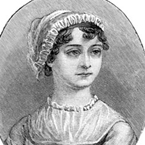
Jane Austen (16 December 1775 – 18 July 1817) was an English novelist known primarily for her six major novels, which interpret, critique and comment upon the British landed gentry at the end of the 18th century. Austen's plots often explore the dependence of women on marriage in the pursuit of favorable social standing and economic security. Her works critique the novels of sensibility of the second half of the 18th century and are part of the transition to 19th-century literary realism. With the publications of Sense and Sensibility (1811), Pride and Prejudice (1813), Mansfield Park (1814) and Emma (1815), she achieved success as a published writer. She wrote two additional novels, Northanger Abbey and Persuasion, both published posthumously in 1818, and began another, eventually titled Sanditon, but died before its completion. Her novels have rarely been out of print, although they were published anonymously and brought her little fame during her lifetime. A significant transition in her posthumous reputation occurred in 1869, fifty-two years after her death, when her nephew's publication of A Memoir of Jane Austen introduced her to a wider audience.