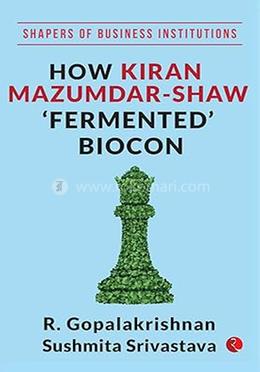
Companies and businesses can be built into great institutions, which are more than engineered processes; they are living organisms with emergent conditions, which bring an institution alive. However, few entrepreneurial leaders break the mould of prevalent thinking and set an organization onto a growth trajectory. They operate with the rainforest rules, which are different from the model of cultivated agriculture based on control, efficiency and replicability. In the rainforest, you accept the environment and within that, you seek effectiveness and novelty. The narrative of Biocon, India’s first and only modern bio-technology institution, led by its founder, Kiran Mazumdar-Shaw, an accidental, yet immensely successful entrepreneur, resembles the application of these rainforest rules. This book is a first-hand account of how Biocon evolved to become an exemplary institution valued at $6 billion, with 11,000 knowledge workers. In a series of personal interviews with Kiran and her team, the authors trace the options that opened up during Kiran’s journey, how she made her choices and the outcomes that impacted the growth trajectory taken by the institution. How Kiran Mazumdar-Shaw ‘Fermented’ Biocon is the third book in the series, Shapers of Business Institutions, which offers instructional and inspirational perspectives for aspirants in the fields of management and entrepreneurship.
This is R. Gopalakrishnan?s eighteenth book. Gopal has played every type of board role on more than twenty-five company boards over thirty-five years. In India and abroad. As CEO, executive director, non-executive director, board chairman, and as independent director. His board experience is rich and has provided him a ring-side view of corporate governance, as it has evolved since its nascent stirrings in the 1990s to its more exhaustive (and exhausting) avatar, now. Governance tends to be obsessed with the technicalities and rules. Gopal believes governance? corporate or public?has as much to do with human behaviour as it is about rules and procedures; it is about neeti (conduct) and neeyat (intent), as much as about niyam (rules)! Gopal welcomes reader feedback at [email protected] Dr Tulsi Jayakumar is Professor of Finance & Economics and Executive Director, Centre for Family Business & Entrepreneurship at Bhavan?s S.P. Jain Institute of Management & Research (SPJIMR), Mumbai. Her research interests span various areas with special focus on behavioural economics and family business. She works extensively with family businesses and is a member of several industrial bodies. She is a thought leader and writes extensively in the media. She believes that most decisions are driven by either the sub-conscious or the unconscious, and a knowledge of the same can make all the difference in the boardroom, and indeed guide any management decision. This is her third book.